Buying Guide
Rolex GMT Master II 16710 Buyer's Guide: Coke vs Pepsi, Cal 3185 vs 3186, and the Stick Dial
How to buy a 16710 GMT Master II: bezel choices, dial generations by lume, the 3185 vs 3186 question, stick dials, and the checks that protect your money.
This post contains affiliate links. I earn a commission if you buy through them, at no extra cost to you. Details. As an Amazon Associate I earn from qualifying purchases. As an eBay Partner, I may be compensated if you make a purchase through eBay links.
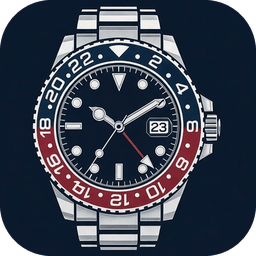
I’ll admit my bias up front. My own GMT Master II is a 1989 Coke, and it is the watch I grab when I get on a plane. The 16710 has a 40mm steel case, an aluminum insert that will fade if you live in it, and a movement that does real GMT work. It is also one of the most faked and most “improved” references Rolex ever made, so it rewards a buyer who does homework.
Here is what I check, in the order I check it.
The basics, so we are speaking the same language
Rolex built the 16710 from 1989 into a 2007 and 2008 transition, when the ceramic 116710LN took over (Bob’s Watches, BezelBase). It has a 40mm Oyster case, 20mm lugs, 100m water resistance, a sapphire crystal, and a bidirectional 24 hour bezel with 120 clicks.
The headline feature is the movement. Calibre 3185 lets you jump the local hour hand on its own in one hour steps while the 24 hour hand keeps home time. That matters because Rolex sold the cheaper GMT Master 16700 alongside it from roughly 1988 to 1999, and that watch used calibre 3175, which cannot jump the hour hand independently (The Watch Build). They look nearly identical. Read the dial. The “II” is not decoration.
Coke, Pepsi, or black
The 16710 came with three factory inserts: red and blue (Pepsi), red and black (Coke), and all black. Because the insert is a simple swap, the bezel on any given watch tells you almost nothing about how it left the factory, and a seller can turn a black bezel watch into a Pepsi in about two minutes.
That is the practical point. Buy the watch, not the insert. Price the case, dial, hands, movement, and bracelet first. Then decide which insert you want. Original faded inserts with even, honest wear can carry a premium. A perfectly crisp insert on a watch that otherwise looks 25 years old is often a replacement, which is fine if you are paying for a replacement.
The Coke is my pick because the black half reads cleanly at a glance and the red is a little less loud than Pepsi on the wrist. That is taste, not investment advice. If you love the look but not the price, I rounded up the affordable Rolex GMT alternatives under $1,000 (publishing November 5).
Dating a 16710 by its dial
Rolex did not announce model years, but the dial text at 6 o’clock gives you the era. Most sources agree on this sequence, with some disagreement about the exact switchover dates (Bob’s Watches, The Watch Build):
| Era (approximate) | Text at 6 | Lume |
|---|---|---|
| 1989 to about 1997 | SWISS T<25 | Tritium |
| about 1998 to 1999 | SWISS | Luminova |
| about 2000 to 2007 | SWISS MADE | Super LumiNova |
Tritium dials and hands age. The plots go cream, ivory, or a darker yellow, and many buyers pay for that look. The catch is that the hands should age in step with the dial. A cream dial paired with bright white hands usually means the hands were replaced at service. Again, not a crime. Just pay for what it is.
Watch for a “SWISS” only dial on an early serial watch. Rolex fitted Luminova dials as service replacements, so a 1991 case with a “SWISS” dial has likely had a dial swap.
Case and bracelet changes worth knowing
A few running changes help you confirm that the parts agree with each other.
- Lug holes. Early cases have drilled holes through the lugs. Rolex dropped them around 2003, and collectors sometimes call the no holes version the “16710T,” although that is not an official reference (BezelBase).
- End links. Hollow end links appear on earlier bracelets. Solid end links arrive around 2000.
- Bracelet type. You will see Oyster bracelets such as the 78360 and 78790, and Jubilee bracelets such as the 62510 (Bob’s Watches). Check the clasp code and the end link numbers, then check that they make sense for the serial.
None of these is a pass or fail test on its own, because bracelets get swapped and serviced. Taken together they tell you whether the watch is consistent or assembled.
Calibre 3185 vs 3186
Almost every 16710 has calibre 3185: 31 jewels, 28,800 vibrations per hour, hacking seconds, and the independent hour hand. At the very end of production, on some late Z and M serial watches, Rolex fitted calibre 3186. The main change is the blue Parachrom hairspring, which resists shocks and magnetism better (BezelBase, The Gentleman’s Reference).
Does a 3186 make the watch better to own? Marginally. Does it make the watch more collectible? Yes, because relatively few exist. That creates an incentive for sellers to claim a 3186 they cannot show you. If the listing says 3186, ask for a clear movement photo or have a watchmaker open it before money moves. A late serial alone does not prove it.
The stick dial
Late in production some dials printed the “II” in GMT Master II as two plain strokes instead of serifed Roman numerals. Collectors call these stick dials. Two myths travel with them, and both are wrong:
- Every stick dial has a 3186. No. Stick dials turn up on late 3185 watches too (WatchProSite).
- It is a factory error. No. It is a typeface change, not an error dial.
One estimate based on several hundred listings puts stick dials at roughly 5 to 7 percent of 16710 supply (The Watch Build). Also note that stick dials were fitted as service replacements, according to Luxury Bazaar as cited by The Gentleman’s Reference. So a stick dial on an early serial watch is a service dial, and it should not carry the late production premium.
To check one, put a loupe on the “II.” Little feet at the top and bottom mean a standard dial. Bare strokes mean a stick dial.
Fakes and frankens
Modern replicas of the 16710 are good enough that photos are not proof. Focus on things that are hard to fake together:
- Serial and reference engravings between the lugs should be crisp and finely cut, not shallow or sandy. The serial is between the lugs at 6, the reference at 12.
- Cyclops magnification over the date should be strong, about two and a half times on a genuine Rolex. Weak magnification is a classic tell.
- Bezel action should be crisp with 120 clicks in both directions on this reference.
- Movement. Nothing replaces a watchmaker opening the case. Insist on it for any purchase that is not from a dealer with a strong return policy.
A “franken” is a real watch built from mismatched genuine parts. These are more common than outright fakes in this price bracket, and they are the reason the dial, hands, bezel, and bracelet checks above matter.
Where to look, and how to price it
I check three places: dealer listings on Chrono24 to see what is out there, eBay sold listings for 16710 to see what actually traded in the last 90 days, and public auction results. Asking prices tell you what sellers hope for. Sold prices tell you the market. I am not quoting a number here because a price without a fresh date is worse than no price at all. Pull your own comps on the day you buy, matched for dial era, bracelet, and box and papers.
Shopping for one? See current Rolex GMT Master II 16710 listings on eBay or current 16710 stick dial listings.
A good 10x triplet loupe pays for itself the first time you read a dial up close. And since this is a travel watch, a padded watch travel case keeps it from knocking around in a carry on.
Quick takeaways
- Confirm it says GMT Master II and that the hour hand jumps on its own. A 16700 is a different watch.
- Ignore the bezel color when valuing the watch. Inserts swap in minutes.
- Match dial text, lume age, hands, lug holes, and end links to the serial era.
- Treat 3186 and stick dial claims as unproven until you see the movement and the “II.”
- Price from sold data dated the week you buy, not from asking prices.
Sources: Bob’s Watches, 16710 history · BezelBase, Reference 16710 · The Watch Build, 16710 guide · The Gentleman’s Reference, 16710 · WatchProSite, the stick dial. Accessed November 2026.